The Hollow
The HollowThe Hollow is the Angkatell family estate and the principal physical and social setting of the novel. It gathers Lucy Angkatell, Henry Angkatell, Henrietta Savernake, Edward Angkatell, Midge Hardcastle, John Christow, Gerda Christow, and their visitors into a country-house weekend whose apparent informality conceals an intricate system of family obligation. The estate is decisive because John Christow's death occurs beside its swimming pool, while the house and its surrounding paths make possible both the original confusion and the subsequent effort to protect Gerda Christow.
Estate and Household
The Hollow is a large, established household in which private rooms, terraces, gardens, woodland paths, and service areas are linked by habits of movement and access. Lucy Angkatell is already awake at 6:13 on a Friday morning, thinking rapidly through the weekend's difficulties and going to Midge Hardcastle's room for consultation. Her restless management of the house begins before the day has properly started, establishing The Hollow as a place governed less by rigid procedure than by Lucy's personal energy and charm.
Henry Angkatell understands the peculiar power of this domestic order. He worries that Lucy does not realize there are things she cannot do, yet he also acknowledges that she repeatedly escapes the consequences of disregarding convention. She has disrupted the traditions of Government House, rearranged dinner-party precedence, placed deadly enemies beside one another, and disturbed the Colour question, while servants who would resist similar treatment from anyone else adore her. The Hollow therefore embodies a form of aristocratic command that is softened, and sometimes concealed, by charm. Its social order can absorb violations because Lucy's authority is personal, inherited, and emotionally persuasive.
That order is not equally accessible to everyone. Midge's presence at The Hollow brings pleasure, but also exposes the gulf between the leisured family and those who must find and retain employment. Lucy, Henry, Edward, and even Henrietta cannot fully understand the insecurity of earning a living; they can offer Midge a home or an allowance, but her independence prevents her from accepting ease as a gift. The estate thus functions as both refuge and boundary. Its well-ordered luxury offers temporary delight while reminding Midge that she does not permanently belong to the class whose security the house represents.
Paths, Pool, and Pavilion
The grounds are organized by several routes that converge around the swimming pool. Inspector Grange reconstructs the movements with precise attention to direction: the lower path comes from the farm, the route taken by Lady Angkatell; Edward Angkatell approaches from the woods by the left-hand path; Henrietta Savernake comes separately by the right-hand path leading from the long flower walk above the house; and the path beside the pavilion continues toward Podder's Lane. Their separate arrivals place the same people within one visible space without giving them the same route, timing, or knowledge.
The swimming pool is therefore more than a scenic feature. It is a spatial mechanism for uncertainty, dividing sightlines while bringing different paths into a single field of suspicion. Above the chestnut trees, a steep track leads to a broader hillside path, a bench, and a curving descent from which only a glimmer of blue water can be seen. Henrietta and Hercule Poirot can stand above the pool without occupying the poolside scene itself. The landscape creates partial views, delayed recognition, and the possibility that an action observed from one angle will be misunderstood from another.
The pavilion adds a smaller, more private enclosure beside the water. After the police have left, Poirot notices that the platinum fox cape has been removed, while six boxes of matches remain on the table by the settee. The damp pavilion is an implausible place to keep so many boxes, and the unexplained matches become another sign that the scene contains arranged details rather than accidental ones. The pavilion's apparently minor objects participate in the larger architecture of concealment.
The Murder Scene and Its Reinterpretation
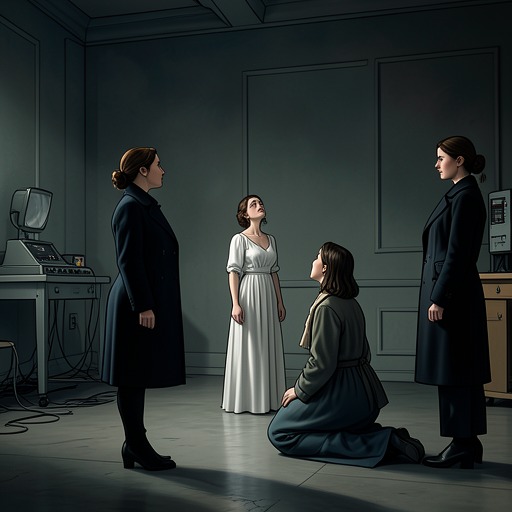
When Poirot first reaches the pool, he believes the Angkatells have prepared a tasteless joke for him. He has been led outdoors instead of into the drawing room, and he is annoyed by what he takes to be an English sense of humour. The scene before him appears unmistakably artificial: a handsome fair-haired man lies beside the pool with one arm flung outward and red paint dripping into the water, while a short, powerfully built middle-aged woman stands over him holding a revolver. Nearby are a tall young woman with a basket of dahlia heads, a tall man in a shooting coat carrying a gun, and Lucy Angkatell with a basket of eggs.
The arrangement resembles theatre as much as evidence. The actors have arrived along different paths, the body is artistically posed, the red substance is conspicuously decorative, and the revolver is displayed as though it were a prop. Yet the scene is not merely a false alarm: the dead man is John Christow, and the artificiality that initially makes Poirot bored eventually becomes the clue to the crime's structure. The poolside tableau converts a murder into a performance, and the house grounds supply the stage, entrances, exits, spectators, and obstructed lines of vision.
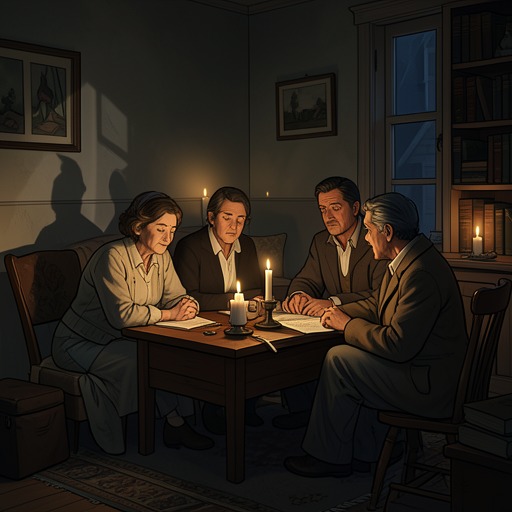
John has earlier returned toward the apparently sleeping house at three o'clock in the morning, anxious about the disorder that Veronica Cray's return threatens to introduce into his life. The French window of the drawing room stands half open for him, but the house looks too innocent, and he imagines that he hears a door closing. The contrast between the innocent appearance of The Hollow and the possibility of a hidden follower gives the estate its most important atmosphere: safety is visible, but not reliable. The house's doors and windows do not simply shelter its occupants; they become signs of unseen movement and withheld knowledge.
Protection, Investigation, and Collective Space
The Hollow's domestic spaces bring the family into contact with modern criminal investigation. Inspector Grange examines the pool, the paths, and the weapon, and asks Henry about his large firearm collection. Henry explains that collecting firearms has been a hobby for many years and confirms that the revolver was unloaded when he put it away. The investigation consequently enters a household whose objects and routines are normally governed by private authority, forcing inherited domestic control to answer to forensic and police procedure.
The collision is softened by the servants' loyalty. When Gudgeon hesitates and glances first toward Henry and then toward Grange, Lucy dismisses him with charm; Grange considers stopping him but allows him to leave. Later, after the crisis has passed, Lucy tells Gudgeon to inform Mrs. Medway and the other servants that she and Henry appreciate the loyalty they have shown. The household's collective silence is not incidental background. It is an active social response, sustained through the hierarchy of the estate and expressed as service, discretion, and protection of the family.
The pool itself changes after the police investigation. Poirot crosses the lane through the chestnuts and sees it deserted, innocent, and peaceful in the soft misty light of Autumn. That restored tranquillity is unsettling because the same place has carried violence, suspicion, and staged appearances. The grounds do not retain the crime as a permanent visible stain; they return to beauty, while the people who know what happened carry the burden of what the landscape conceals.
House, Studio, and The Hollow as Echo
The Hollow's meaning extends beyond its garden. Henrietta's studio in London offers a contrasting private space filled with wood and bronze figures: a bronze head in a tin hat, twisted aluminum, a pinkish granite frog, and an almost life-sized wooden figure. Midge feels eerie while wandering among these creations, and the studio's artificial bodies echo the artificial body at the pool. The estate's staged murder and the studio's sculptures belong to different worlds, but both make visible the novel's concern with constructed forms, poses, and the unstable boundary between living presence and arranged appearance.
At the end, Poirot tells Henrietta that he sensed from the beginning that the scene had been set. He did not initially understand that Gerda had made it theatrical by acting a part, nor that Henrietta's ingenuity and the aid of her relations had sustained the deception. Henrietta explains that John had called her name as a request to protect Gerda, and that she believed he loved Gerda more deeply than he understood. The Hollow thus becomes the place where a family transforms a murder scene into a protective fiction: Gerda's guilt is hidden not by one person's action alone, but by a network of relatives and servants using the estate's intimacy as cover.
The house finally stands as an echo of its inhabitants. Its apparent innocence repeats the family's wish to preserve order; its converging paths repeat the tangled relations that brought them together; its rooms and servants provide privacy, movement, and silence; and its beautiful grounds allow violence to be absorbed into an ordinary landscape. The Hollow is simultaneously home, social boundary, theatrical stage, investigative problem, and instrument of concealment. Its decisive significance lies in the way it turns architecture and landscape into moral evidence: the place does not merely contain the mystery, but helps produce the misunderstandings and loyalties through which the mystery survives.